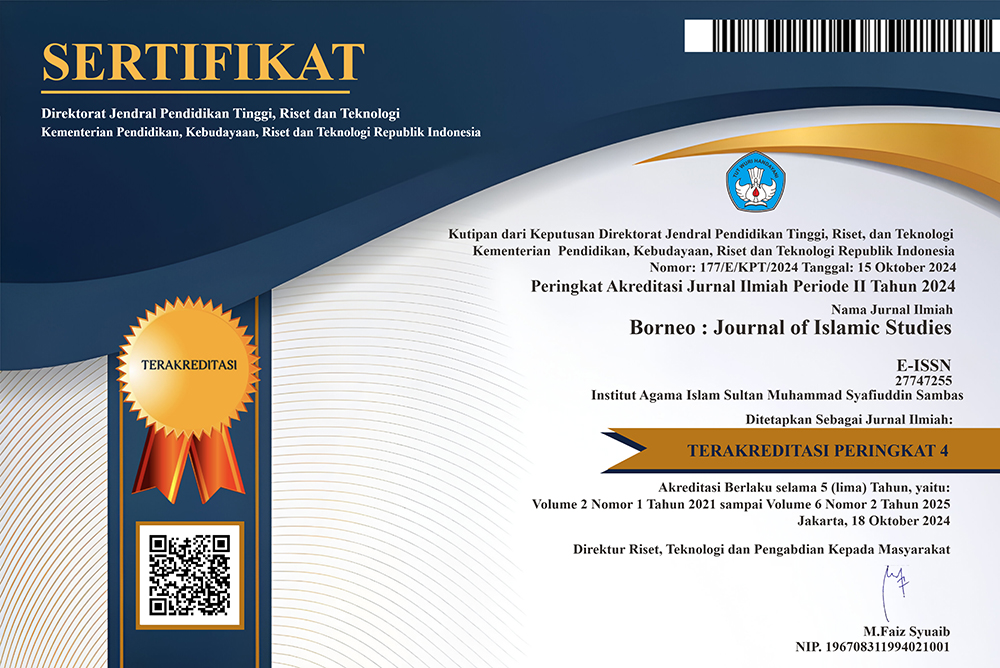
Accreditation

Borneo: Journal of Islamic Studies accepts manuscripts that contribute to the advancement of Islamic studies and align with the journal’s aims and scope. Manuscripts must be original, previously unpublished, and not under consideration for publication by another journal. The journal considers field research articles, library-based research articles, book reviews, and systematic literature review articles. All submissions must demonstrate academic rigor, originality, analytical depth, and a clear contribution to the development of Islamic studies.
Field research articles report empirical findings derived from systematic engagement with research participants, communities, institutions, or social settings relevant to Islamic studies. These studies may employ qualitative, quantitative, or mixed-methods approaches, using appropriate data collection techniques such as observation, interviews, surveys, and documentary analysis.
Manuscripts must clearly articulate the research problem, objectives, and questions, as well as their relationship to previous scholarship. Authors must explain the research design, data collection procedures, analytical methods, and relevant ethical considerations. Where applicable, manuscripts should describe procedures for obtaining informed consent, protecting participants’ confidentiality, and ensuring responsible research practices.
The findings must be presented systematically and discussed critically in relation to relevant theories, previous studies, and broader scholarly debates. Authors should demonstrate how their findings contribute to the understanding and development of Islamic studies while acknowledging the limitations and implications of the research.
Library-based research articles examine questions in Islamic studies through the critical analysis and interpretation of written, textual, historical, or documentary sources. Relevant sources may include classical and contemporary Islamic texts, the Qur’an and Hadith, books, manuscripts, scholarly articles, archival materials, legal documents, and other sources appropriate to the research question.
These articles may investigate Islamic concepts, religious thought, intellectual traditions, historical developments, scholarly interpretations, comparative perspectives, or normative and theoretical questions. Authors must clearly identify the research problem, explain the rationale for selecting sources, establish the scope of the inquiry, and describe the analytical or interpretive approach employed.
The manuscript must demonstrate a systematic and critical engagement with the selected sources. Authors are expected to develop coherent arguments, interpretations, or conceptual syntheses that contribute to scholarly discussions in Islamic studies. A descriptive account or summary of existing literature without critical analysis, a clear argument, or an identifiable scholarly contribution is insufficient for publication as a library-based research article.
Book reviews provide critical and balanced assessments of scholarly books relevant to the aims and scope of Borneo: Journal of Islamic Studies. Reviews may address recent publications or significant scholarly works that remain relevant to current developments and debates in Islamic studies.
Each submission must include complete bibliographic information for the book under review, including the author or editor, title, publisher, publication year, total page count, and ISBN, where available.
A book review should introduce the book’s subject, scope, objectives, and central arguments before critically evaluating its theoretical approach, methodology, use of sources, organization, strengths, limitations, and contribution to the relevant field. Reviewers should situate the book within broader scholarly discussions and explain its significance for researchers, lecturers, students, and other readers interested in Islamic studies.
Book reviews must offer an independent scholarly assessment rather than merely summarize the contents or promote the publication. Reviewers must disclose any personal, professional, financial, or other relationships that could reasonably be perceived as influencing their assessment. The editorial team may establish additional requirements concerning the eligibility, publication date, length, and format of books submitted for review.
Systematic literature review (SLR) articles synthesize existing research to address clearly defined research questions through transparent, systematic, and reproducible procedures for identifying, selecting, evaluating, and analyzing relevant scholarly literature.
Manuscripts must specify the databases, repositories, journals, or other sources searched; search strategies and keywords; search dates; publication period covered; and inclusion and exclusion criteria. Authors must explain the procedures used to screen records, assess eligibility, select studies, and extract relevant information. The manuscript should also describe the quality appraisal procedures, where appropriate, and the methods used to synthesize the evidence.
The selection process must be documented transparently, including the number of records identified, screened, assessed for eligibility, and included in the final review. Reasons for excluding studies after full-text assessment must be reported clearly. Where applicable, authors are encouraged to use established reporting guidelines, such as PRISMA, to improve the transparency and completeness of the review.
The review must go beyond summarizing previous publications. It should identify major themes, patterns, theoretical developments, similarities and differences among findings, limitations in the existing evidence, and gaps that warrant further investigation. The discussion must explain the implications of the synthesis for the advancement of Islamic studies. Bibliometric analysis may complement an SLR but cannot replace substantive critical analysis and synthesis of the included literature.
All manuscripts submitted to Borneo: Journal of Islamic Studies must follow the journal’s author guidelines regarding structure, formatting, citation style, references, language, and submission procedures. The manuscript structure should be appropriate to the type of submission and the research objectives.
Field research articles, library-based research articles, and systematic literature review articles must provide a clear explanation of their research methods or analytical procedures. Book reviews must follow a structure that supports critical evaluation and scholarly discussion of the work under review.
All submissions are subject to editorial screening and, where appropriate, peer review in accordance with the journal’s editorial and publication policies. The editorial team evaluates manuscripts based on their relevance to the journal’s aims and scope, originality, academic integrity, methodological or analytical rigor, quality of argumentation, clarity of presentation, engagement with relevant scholarship, and contribution to the field of Islamic studies.
Submission does not guarantee acceptance or publication. The editorial team reserves the right to reject manuscripts that fall outside the journal’s scope, fail to meet the required academic standards, do not comply with the author guidelines, or raise concerns regarding originality, research ethics, or publication integrity.

All publication by Borneo: Journal of Islamic Studies licensed under a Creative Commons Attribution-ShareAlike 4.0 International License.
Publisher:
Institut Agama Islam Sultan Muhammad Syafiuddin Sambas, Jl. Raya Sejangkung No.126, Sambas,
Kalimantan Barat, Indonesia.